
Your viewers do not all have the same internet connection. Some are on fast home broadband, some are on hotel wifi, some are on a phone with two bars of signal. A single stream cannot suit all of them at once: make it good enough for the fast connections and the slow ones will stall, make it safe for the slow ones and everybody gets a soft, blurry picture.
Adaptive Bitrate (beta) solves this. Instead of one version of your stream, several are made available at different quality levels, and each viewer’s player quietly picks the one their connection can handle – switching up when things improve and down when they don’t, on its own, without the viewer touching anything.
It is the same behaviour you are used to on the large video sites, where the picture occasionally softens for a few seconds during a rough patch and then sharpens up again. Most people never consciously notice it – which is exactly the point.
Do you need it? #
Usually, yes. Unlike some features, this one helps the widest range of streams, and it is worth turning on whenever your audience is varied – which, if people are watching from home, from their phones, or from other countries, it certainly is. What you get:
- Fewer interruptions. A viewer whose connection dips drops to a lower quality for a moment instead of freezing on a spinning wheel. They keep watching; you keep your audience.
- Faster starts. Players can begin on a lighter version and step up, so your stream appears sooner after someone clicks play.
- Less bandwidth used overall. Viewers who don’t need the full-quality version don’t receive it, which means the hours on your plan stretch further.
- Proven in practice. The feature has been running in production for many of our customers, with consistently good results.
The case for leaving it off is narrow: an audience you know is entirely on strong, stable connections – a company network, a venue you control – where the extra flexibility buys you nothing.
Turning it on #
Go to your Channel, click “Channel Settings”, and enable “Adaptive Bitrate (beta)”:
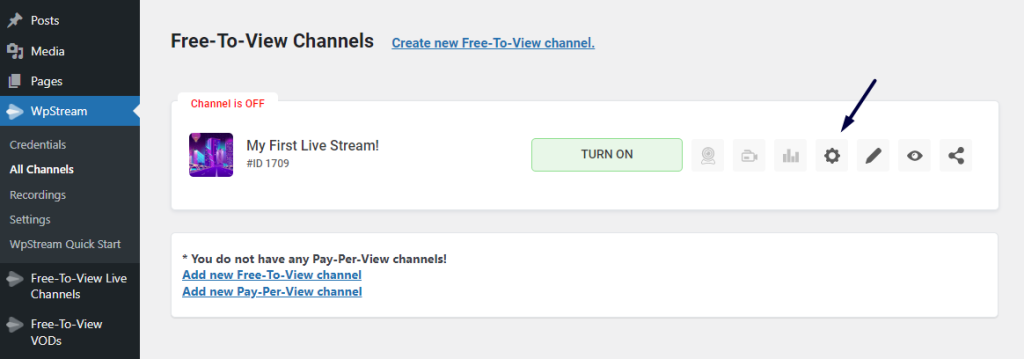
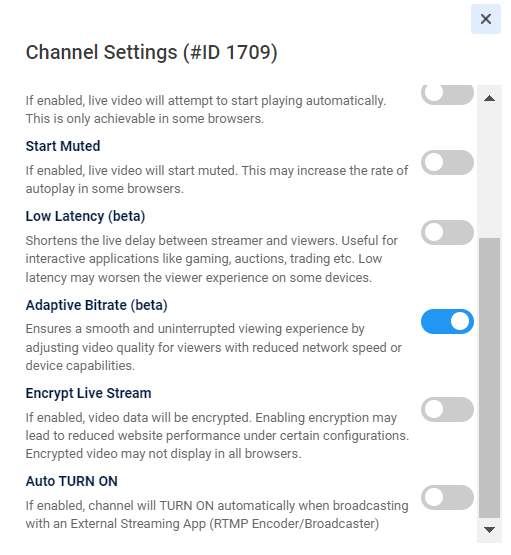
You can then TURN ON your channel and stream as usual – there is nothing further to do, and nothing your viewers need to change.
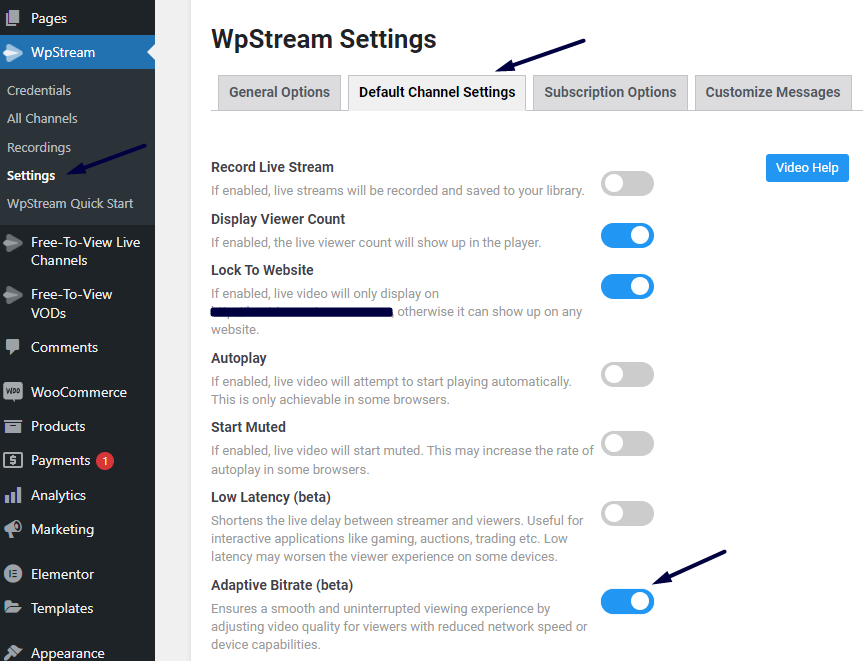
To have it on for every channel you create from now on, go to WpStream Settings > Default channel settings and enable it there:
Settings for your broadcasting software #
Happily, there is very little to change. Adaptive Bitrate works with whatever you are already streaming: any resolution, any shape – widescreen, vertical, square – any bitrate you like, and whichever encoder your software or hardware uses. Your audio settings can stay exactly as they are.
There is one setting worth getting right, though. Set your keyframe interval to 5 seconds. Think of a keyframe as a fresh, complete picture: spacing them 5 seconds apart gives us clean, evenly sized pieces of video to build the different quality versions from, and makes the switch between qualities smoother for your viewers. In OBS Studio you will find it under Settings > Output, with the Output Mode set to “Advanced”.
One thing worth stressing: Adaptive Bitrate cannot rescue a broadcast that is already struggling. It needs a fast, steady upload from you – steady to anywhere in the world, not just to sites in your own city or country. If your streams are stuttering or dropping out today, this feature will make matters worse rather than better. Sort the upload out first.
Using it together with Low Latency #
You can switch both on for the same channel, but we do not recommend it. The two features pull in opposite directions: Low Latency works by stripping away the small reserve of video a player holds back, while Adaptive Bitrate relies on a comfortable reserve to judge how a connection is doing and to change quality smoothly. They also ask for different keyframe settings – 1 second against 5. Run them together and each works less well than it would on its own.
So pick the one your stream actually needs. If a delay of a few seconds would genuinely change things for your audience – an auction, live betting, gaming with your viewers – use Low Latency. For everything else, and that is most streams, Adaptive Bitrate is the one that will serve your audience better.


